Guide
Bread Proofing and Baking Guide (Times & Temps)
Ad links. We may earn a commission on purchases, at no extra cost to you.
Proofing (fermentation) is the rise that develops flavor and structure before baking. Yeast works faster as the dough gets warmer and slows as it cools, so the same recipe can take 45 minutes in a warm kitchen or overnight in the refrigerator. Treat every time in this guide as an estimate: your flour, hydration, yeast amount, and room temperature all shift the clock. The reliable signals are how the dough looks and feels, plus the internal temperature at the end of the bake.
How to use this guide
- Find your dough or kitchen temperature in the proof table for a starting time window.
- Watch the dough, not just the clock: bulk fermentation is done when the dough is puffy and about doubled; the final proof is done when a gentle poke springs back slowly (see the poke test below).
- Choose an oven temperature from the bake table based on whether your bread is lean or enriched.
- Confirm doneness with an instant-read thermometer inserted into the center of the loaf.
- Adjust for your oven and climate; a warm, humid kitchen or a hot-running oven will speed everything up.
| Bread type | Oven temperature | Internal doneness temp |
|---|---|---|
| Lean (baguette, sourdough, ciabatta, rustic boule) | 450-500°F (230-260°C), often with steam | 205-210°F (96-99°C) |
| Sandwich / soft white loaf | 375-400°F (190-205°C) | 200-205°F (93-96°C) |
| Enriched (brioche, challah, milk bread, dinner rolls) | 350-375°F (175-190°C) | 190°F (88°C) |
| Sweet rolls (cinnamon rolls, sticky buns) | 350°F (175°C) | 190°F (88°C) |
Key tips and tests
- Windowpane test (for kneading): pull off a small piece and stretch it thin. If it forms a translucent membrane without tearing, the gluten is well developed and the dough is ready to rise.
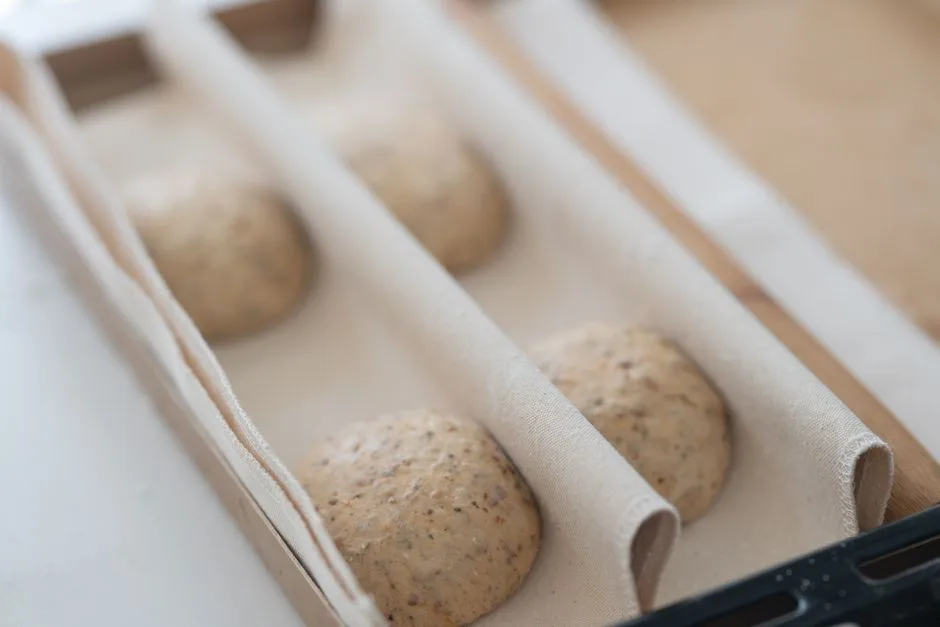
- Poke test (for final proof): flour a finger and gently press the shaped dough about a half inch. If the dent springs back slowly and leaves a slight mark, it is ready to bake. If it springs back fast, give it more time; if it collapses and does not recover, it is overproofed.
- Lean breads need higher heat and steam for oven spring and a crisp, deeply colored crust; enriched breads have sugar, eggs, butter, or milk that brown faster, so bake them cooler to avoid burning.
- Pull enriched loaves at the lower internal temperature (about 190°F / 88°C) so they stay soft; taking them to 205°F+ dries them out.
- Cold-retarding dough in the fridge develops flavor and makes timing flexible; let refrigerated dough warm and finish proofing before baking.
- If you bake a bread with a meat filling (for example a sausage roll or chicken-stuffed bread), the meat, not the crust, sets doneness: cook chicken to a USDA-safe 165°F (74°C) and ground meats to 160°F (71°C).
| Environment / dough temp | First rise (bulk fermentation) | Final proof (shaped) |
|---|---|---|
| Refrigerator, cold retard (38-40°F / 3-4°C) | 8-48 hours | 12-16 hours (overnight) |
| Cool room (60-65°F / 16-18°C) | 2-3 hours | 1.5-2 hours |
| Room temperature (70-75°F / 21-24°C) | 1-2 hours | 45-60 minutes |
| Warm spot (80-85°F / 27-29°C) | 45-60 minutes | 30-45 minutes |
| Proof box / oven with light on (90-100°F / 32-38°C) | 30-45 minutes | 20-30 minutes |
How do I know when the first rise is done?
The dough should look puffy and be about doubled in volume. A finger pressed into it leaves a dent that fills back in slowly. Volume is a better guide than the clock, since temperature changes the timing a lot.
Why is my bread taking much longer than the recipe says?
A cool kitchen, cold ingredients, older yeast, or a stiff, low-hydration dough all slow fermentation. Move the dough somewhere warmer (around 78-82°F / 26-28°C) and give it more time. The times in recipes assume a fairly warm room.
What internal temperature means bread is fully baked?
Lean breads are done at about 205-210°F (96-99°C) in the center. Enriched and sweet breads are done softer, around 190°F (88°C). An instant-read thermometer in the middle of the loaf is the most reliable test.
Can I speed up proofing?
Yes. Use a warm spot such as an oven with just the light on or a proof box at 90-100°F (32-38°C). This can roughly halve the time. Do not go much hotter than about 100°F (38°C), though: the dough over-ferments and the flavor suffers, and once the dough itself reaches roughly 130-140°F (54-60°C) the heat starts to kill the yeast.
What happens if I overproof the dough?
Overproofed dough loses its gas and structure: it looks slack, may deflate when moved, and bakes into a dense, flat loaf. If you catch it early, gently reshape and do a short final proof before baking.
Related guides