Recipe
Classic Sourdough Boule Recipe
This page contains affiliate links – if you buy through them we may earn a commission, at no extra cost to you. The recommendations are our own assessment. As an Amazon Associate we earn from qualifying purchases.
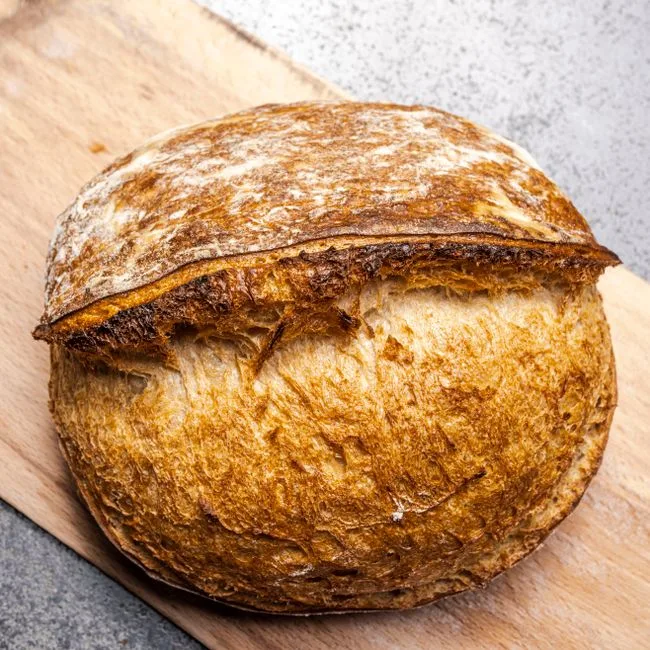
A round, crusty naturally leavened loaf with an open crumb, baked in a Dutch oven. It uses only flour, water, salt and an active starter, and the timeline runs over two days with about 40 minutes of hands-on work. This is the baseline sourdough - learn it first and the other variations follow easily.
Classic Sourdough Boule
Ingredients
- 100 g active sourdough starter (100% hydration, fed 4-8 hours earlier)
- 350 g water (about 1 1/2 cups), room temperature
- 500 g bread flour (about 4 cups)
- 10 g fine salt (about 1 3/4 tsp)
- 2 tbsp (15 g) rice flour or plain flour, for dusting the banneton
Instructions
- Feed your starter 4-8 hours ahead. It is ready when it has doubled, domed and a spoonful floats in water.
- Mix the flour and water in a large bowl until no dry flour remains, then rest 45 minutes.
- Add the starter and salt and squeeze them through the dough with wet hands until fully incorporated.
- Perform 4 sets of stretch-and-folds over the next 2 hours, 30 minutes apart.
- Leave covered until the dough has risen about 50% and feels airy and domed - roughly 4-6 hours total at 75°F (24°C), considerably longer in a cool kitchen.
- Shape into a tight round and place seam-side up in a floured banneton or a bowl lined with a floured tea towel.
- Cover and refrigerate 12-16 hours.
- Put a Dutch oven with its lid inside the oven and heat to 480°F (250°C) for 45 minutes.
- Score the cold dough, lower it into the hot pot on parchment, cover and bake 20 minutes. Remove the lid, reduce to 430°F (220°C) and bake 20-25 minutes more, to a deep brown crust and 210°F (99°C) in the centre.
- Cool on a rack at least 2 hours before cutting.
Internal temperature is the honest doneness check: 210°F (99°C). A loaf that sounds hollow but reads 195°F (90°C) will be doughy at the centre.
Tips
- Judge bulk fermentation by the dough, not the clock - a kitchen at 68°F (20°C) can easily double the times given here.
- The float test on your starter is the most reliable go/no-go signal you have. If it sinks, feed it again and wait.
- Score with a single decisive slash about 1/2 inch (1 cm) deep at a shallow angle; timid scoring gives you a burst side seam instead.
- No Dutch oven? Bake on a preheated stone with a metal bowl inverted over the loaf for the first 20 minutes.
FAQ
What usually goes wrong?
Cutting into it warm. The crumb is still setting and the interior turns gummy and sticky; two hours of cooling is part of the recipe, not a suggestion.
How do I store it?
Cut side down on a board at room temperature for 3 days, or sliced and frozen for 3 months. Do not refrigerate - it goes stale faster than at room temperature.
What core temperature should it reach?
Cook to a core temperature of 99 °C, measured at the thickest point.
Why do my times differ?
Ovens differ. Use the times as a guide and judge by how it looks and feels.
Related guides